Change management is one of those terms that consultants love putting on slide decks and management loves talking about. There are frameworks, methodologies, step-by-step guides, and entire consulting practices built around it.
And yet, many change management initiatives fail.
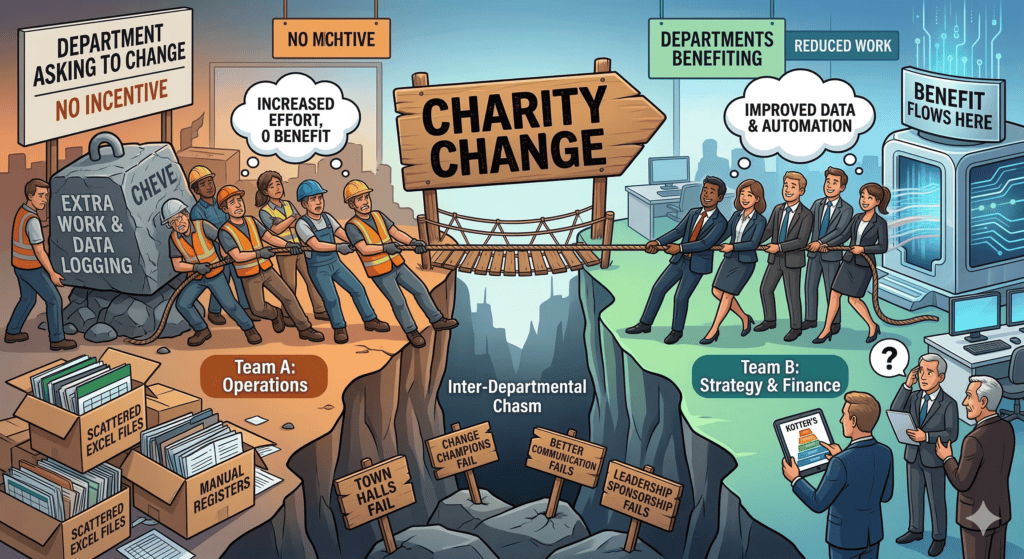
This is because most frameworks treat resistance as an irrational human response which can be overcome through communication and training. In my experience, sometimes this is not the case. Resistance is sometimes completely rational — because the people being asked to change have absolutely nothing to gain from it.
I call this Charity Change.
What is Charity Change?
Charity Change happens when one department is asked to change their working style, to do things differently, to put in extra effort, to absorb new processes — while the benefit flows entirely to a different department or function. In some cases, the change is actually counter-productive to the team being asked to make it.
This is not a motivation problem. It is a alignment problem.
No amount of town halls, change champions, or communication can fix this. Because the team resisting isn’t confused about the change. Rather they understand it perfectly. They just have no reason to embrace it.
Two Examples From the Ground
Example 1: The Sales Team and the Strategy Report
Imagine a sales team operating in a commodity/me-too market where pricing is entirely driven by market forces. The team has zero control over pricing and are mostly reacting to it. Now the Strategy function asks them to log their full pricing rationale into the system for every order. That takes 5–10 minutes per order, which may add up to 45 minutes to an hour of extra work every single day.
The sales team’s natural response is: “Should we be in the market talking to customers, or should we be doing data entry?”
But the resistance runs deeper than this. The sales team knows this analysis will be pulled out in review meetings to question decisions they had no control over. The resistance is not because of laziness. They are resisting because they can see exactly how this ends, and it is not in their favor.
Example 2: The Maintenance Team and the Finance Report
A maintenance team already tracks hourly machine performance in Excel. The data is accurate and complete. Finance needs this data for monthly costing. Currently, Finance collects the Excel files from Maintenance and processes them manually.
A new system is suggested, and Maintenance is now asked to log this same data directly into the system. This task increases their daily effort from 15 minutes to 45 minutes. The benefit? Finance can now pull the reports themselves without chasing Excel files.
The Maintenance team’s internal monologue is natural: “I am doing more work so that Finance’s work reduces.”
They are not wrong.
Why Standard Change Management Doesn’t Work Here
The reason Charity Change is so resistant to standard approaches is that it violates the basic principle that most frameworks work on. Most change management frameworks assume the resistance is in the mind — fear of the unknown, coming out of comfort zone, lack of communication. The typical response is more town halls, better communication plans, and senior leadership sponsorship.
But no one addresses the actual problem: there is genuinely nothing in it for the team being asked to change.
Inter-departmental politics makes this worse. Departments that are structurally and naturally in tension, such as Sales and Strategy, Operations and Finance, IT and everyone else, carry historical friction into every cross-functional initiative. Asking them to do extra work for each other doesn’t just face indifference, it faces outright rejection.
What Actually Works: Two Honest Approaches
There is no magic framework here. In my experience, you need either a genuine incentive or a structural inevitability. Everything else is noise.
The Carrot Approach: Make It Worth Their While
- Automate as much as possible. Before asking a team to take on extra work, exhaust every option to reduce that burden technically. Pre-filled fields, system integrations, auto-capture from existing tools, bots etc. Every minute you take off the extra effort reduces resistance significantly. The goal is to make the change feel trivial rather than burdensome.
- Bundle it with something they actually want. When the impacted team has a pending request like a system improvement, a process fix, a long-standing grievance, bundle the Charity Change into that delivery. People are more likely to accept a package deal than a standalone imposition. Fair warning: this only works if the bundle actually solves some problem and you are genuinely trying to help them as well. If it feels like a trick to make them except your changes, you will lose trust instantly.
- Compensate the effort directly. If a team is genuinely absorbing cost or effort for another team’s benefit, it should be formally recognized. This could be through KRA adjustments, incentive structures, or even just visible senior acknowledgment. Invisible effort often breeds resentment.
The Stick Approach: Remove the Choice
- Make it their KRA. If the Sales team needs to log pricing rationale, stop framing it as a request from Strategy. Make it a deliverable in their own performance review. When their own manager asks for it in their own review meeting, the dynamic changes completely.
- Redesign the process so the extra step is unavoidable. This is the most powerful approach, and the most underused. If you are implementing a new system, design the workflow so that the team’s own tasks cannot be completed without first entering the required data. A maintenance engineer cannot log a work order closure without entering the machine performance data. A sales executive cannot raise an invoice without completing the pricing rationale. The change stops being optional. This approach requires upfront design investment, but it eliminates adoption risk almost entirely.
What I have learned
Charity Change is structurally different from ordinary change management. The resistance isn’t irrational, it’s a correct reading of a misaligned situation. Treating it with standard communication plans and leadership sponsorship is like prescribing painkillers for a broken bone. It might dull the discomfort temporarily, but it doesn’t fix the actual problem.
The real fix is either to rebalance the equation. Give the impacted team a genuine reason to act, or to redesign the system so that compliance becomes the path of least resistance, not an act of corporate charity.
Every Charity Change situation is different. But the core question remains the same: What does the team being asked to change actually get out of this?
If the answer is nothing, it is not a change management problem. It is a design problem.